what tectonic setting is interpreted to be the cause of volcanism at yellowstone
Information is preliminary and subject to change. All times are local (unless otherwise noted)
September 1989 (SEAN 14:09)  Cite this Report
Shallow steam explosion destroys geyser
The following is from Roderick Hutchinson. "At approximately 1440 on five September, Porkchop Geyser in the Norris Geyser Bowl (roughly 44.7°N, 110.7°Due west) of Yellowstone National Park was destroyed by a shallow steam explosion. Eight visitors witnessed its water-steam mixture eruption column reach an estimated height of 20-30 m from its normal vi-9 1000 presently earlier the whole siliceous sinter formation suddenly blew upwardly. In 'simply a few seconds' information technology threw sinter blocks out in a fan-similar way, mainly to the North and S, rupturing the geyser'due south vent, hot water basin, and surrounding sinter sheet platform. Maximum range of ejecta was 66.one k South, 43.4 m Northward, 31.5 m W, and simply 25.6 1000 Due east toward the boardwalk. An ejecta rim 1-1.4 m loftier, 13.9 k long on a Northward-S centrality, and 11.seven m wide was formed around a newly created boiling leap. Much of its volume consisted of large sheets or plates of moderate to dense siliceous sinter buckled loose from the flooring of the thermal basin and thrust vertically or overturned. The largest sinter cake bandage out had dimensions of one.88 ten 1.23 ten 0.75 g. Within the ejecta rim, a new hot spring, supersaturated with silica, has emerged and is currently 5.5 x 4.0 m across and 3.23 m deep.
"Porkchop Geyser was a small unnamed spring, notable at to the lowest degree as early equally 1927, because of its exceptionally loftier contents of Cl and SiOii; it remained unnamed until 1961, when information technology was informally called Dr. More'south Porkchop by Donald Due east. White of the USGS, and afterward shortened to Porkchop Geyser. The proper noun was derived from the shape of the geyser's puddle. Porkchop unremarkably had a slightly surging non-opalescent discharge; rarely, a geyser eruption 3-5 m high emptied its pool. Beginning in late Mar 1985, it started erupting equally a perpetual spouter from an empty crater through its two'3.5 cm triangular vent. Over the last 4 years, the geyser's eruption column was of sufficient velocity to be atomized into a fine spray that during winter formed ice cones > 7 g high and produced an eruption roar audible up to 2 km away.
"The devastation of Porkchop Geyser coincided with and was probably triggered by an almanac widespread thermal disturbance in the Norris Geyser Basin. These hydrothermal events are characterized by briefly increased water and gas belch, increased turbidity, extreme fluctuations in surface temperatures, amending of geyser eruptive patterns, and in some years also include the creation of new thermal features. These disturbances have been observed nearly every twelvemonth since 1971 when more detailed record keeping began."
Further References. Dzurisin, D., and Yamashita, K., 1987, Vertical surface displacements at Yellowstone Caldera, Wyoming, 1976-1986: JGR, v. 92, p. 13,753-13,766.
Smith, R.B., Reilinger, R., Meertens, C., Hollis, J., Holdahl, S., Dzurisin, D., Gross, West., and Klingele, E., 1989, What'south moving at Yellowstone?; the 1987 crustal deformation survey from GPS, leveling, precision gravity, and trilateration: EOS, v. 70, p. 113, 119, 123-125.
Information Contacts: Roderick A. Hutchinson, Yellowstone National Park.
March 1992 (BGVN 17:03) Cite this Report
Stiff new thermal activity
In 1985, a new superheated fumarole formed on the upper E margin of the Mushpots thermal area, which lies on the E side of the caldera associated with the youngest of Yellowstone'south three cycles of voluminous rhyolitic volcanism, 0.6 million years ago. The presence of vegetation and the express extent of bare thermal ground indicated that heat flow near the site of the new fumarole had been moderate to low for at least the previous 15 years. Interviews with park personnel strongly suggested that activity began most 3 July 1985. The steam deject from the vent may take inspired a imitation report of smoke from the area, but the vent was not discovered until 5 October 1986, during fieldwork by C. Craig-Hunter and Roderick Hutchinson. At that time, the fumarole's transparent dry-steam jet was directed upslope N35°W at an estimate angle of 21°. A pocket-size, cerise-brown, iron-stained cone of hydrothermally contradistinct sand-sized material had grown ~ 0.5 1000 above the uphill side of the rectangular i.35 x 1.9-g vent, which dipped at an bending under the lower S rim. Just below the fumarole, on the flooring of an old thermal zone, were numerous new or recently enlarged, small, steaming, thermal and mud pot vents, covering an expanse ~ 10 m in diameter. Sulfate and/or yellow elemental sulfur deposits covered nigh of the area and nearby slopes to the Due west, SW, and NW. A 2nd area of new or rejuvenated thermal vents was also discovered in the drainage to the south.
Many trees had been killed in line with the fumarole's directed plumage and around the margins of the old thermal zone. Mature trees as much equally 87 cm in bore were snapped off at ground level or uprooted, and tops were broken on other trees twoscore chiliad from the rim of the old thermal zone (54 k from the fumarole). A narrow zone of hydrothermally contradistinct white chips of glacial till was found amidst the toppled trees upward to 40 m from the thermal zone rim. These ejecta were 6 cm deep on the rim in 1986.
Geologists returned on 12 February 1987, after a nearby Univ of Utah seismograph . . . detected an isolated episode resembling volcanic tremor. The fumarole'due south temperature had increased (figure 1) and more elemental sulfur and iron sulfates had been deposited in the old thermal zone, but no other changes were evident. Since so, a biannual survey has been conducted in the area.
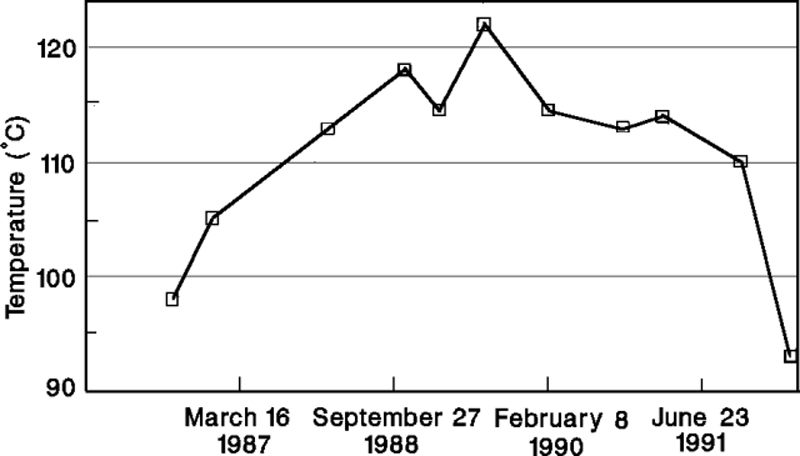 | Figure 1. Temperatures measured at Mushpot Fumarole, Yellowstone National Park, 5 October 1986-28 March 1992. Courtesy of R. Hutchinson. |
During fieldwork on 28 March 1992, a tranquillity cloud of moisture, 93°C vapor filled the 1985 fumarole's vent. However, less than 30 yard downslope (S), on the E margin of the erstwhile thermal zone'due south floor, the ground was shaking violently with the formation and growth of a new mud pot. Bursts of thick, gummy mud were typically doming to 2 thou and occasionally to 5 one thousand in diameter before exploding to 3-half-dozen k height. Each explosion shook the basis in all directions. Branches of thermally killed trees shook fifty m away, the footing was visibly moving 8-10 m from the rim, and within four one thousand of the rim was behaving like pudding, with vehement shaking causing surface oscillations of 1-2 cm. During 90 minutes of observations, the surface area of the mud pot increased past ~ 50%, to an estimated 11 x 7 m. It had a depth of at least 2 yard. The minimal amount of ejected mud surrounding the crater and the intense shaking suggested that development of the mud pot had begun within the last 24 hours.
Data Contacts: Roderick A. Hutchinson, Yellowstone National Park.
October 1995 (BGVN 20:10) Cite this Study
New mud volcano, minor mud flow, and associated thermal features
On the SW flank of Sour Creek resurgent dome W of Astringent Creek in the 0.6 Ma Yellowstone caldera, is an extensive, unnamed acid sulfate hydrothermal system (figures 2 and 3). Surface expression of the ~3 km2 thermal area consists of discontinuous high temperature altered basis, turbid springs, pools, seeps, fumaroles, mud pots, a large gas- and sulfur-rich acrid lake, and numerous sublimated sulfur mound deposits interspersed amidst low-temperature woods-covered basis.
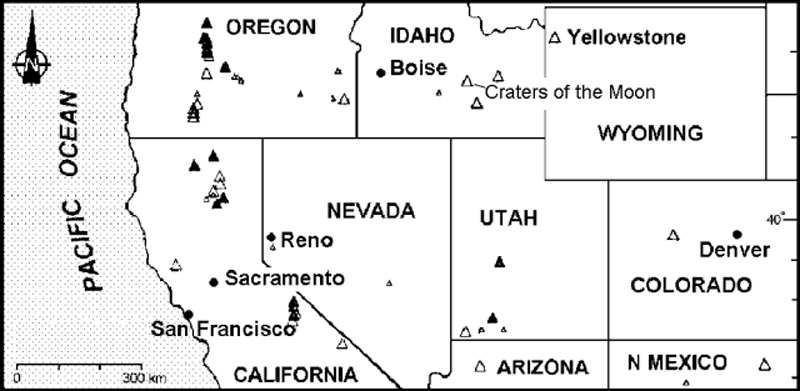 | Effigy ii. Alphabetize map of the western United states of america showing the location of Yellowstone Caldera. |
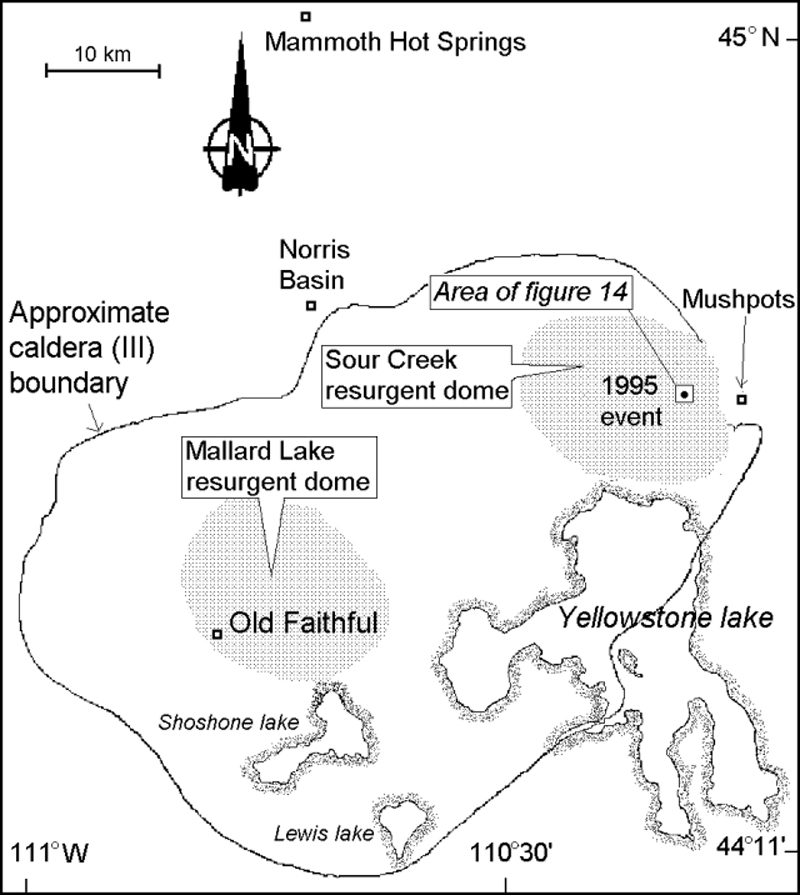 | Figure 3. Sketch map of Yellowstone Caldera indicating the location of the recent thermal features described in this and an before written report. |
During early 1990, a meaning rise in temperature in the upper NW cease of the hydrothermal system began killing former-growth pine trees. Within a twelvemonth, a new super-heated fumarole emerged, blanketing the downed trees and roots with a layer of hydrothermally altered coarse sand from a directed blast to the N.
The temperature and volume of dry steam venting from the deep "shaft-like" vent steadily increased over the adjacent three years, with the temperature reaching a maximum of 104.iii°C on 8 October 1994, ~eleven°C higher than the local boiling signal. The dynamic activity of the fumarole and surrounding hot ground was only monitored almost twice a year over the three years post-obit its 1990 inception due to its remote location and restricted access.
A similar progression was previously seen during 1985 in an area ~4.5 km to the E. This area, the upper Due east margin of the Mushpots thermal surface area, sits on the West flanks of Pelican Cone (BGVN 17:03). The progression went from new hot ground and dying mature forests, to the vigorous breakout of a dry, super-heated fumarole with progressively hotter temperatures over time, followed by sudden emergence of a large and violent mud volcano. Both the 1985 and recent thermal features had similar fluid compositions.
During 1992-94 the unnamed thermal area W of Severe Creek developed a series of seven large craters that evolved as the Mushpots thermal area did in 1985. The craters were progressively younger towards the SW, ending at the site of the current new hot ground and fumarole (figure iv). In Dec 1993, National Park Service enquiry geologist R. Hutchinson predicted that the newest superheated fumarole would soon evolve into a large mud volcano.
 | Effigy 4. Sketch map (calibration approximate) showing the surface expression of an unnamed thermal surface area W of Severe Creek in Yellowstone Caldera. Coordinates for map's centre are at about 44°38'06"Due north, 110°16'44"W. Courtesy of R. Hutchinson. |
As a office of routine monitoring, the thermal area Westward of Astringent Creek was inspected on 7 June 1995. The former 104.3°C fumarole was replaced by a large vigorous mud pot with ejecta extensively scattered around it. In addition, two new smaller roaring fumaroles at or slightly above humid point, 3 new moderate-sized churning caldrons (pits containing hot, agitated aqueous fluids), numerous smaller muddy pools, plummet pits, and frying-pan springs (audibly degassing springs) were apparent then. All-encompassing areas of unstable quicksand-like saturated footing made up of scalding mud were found under the fallen trees. Some regions were heavily encrusted with sulfate minerals or sulfur crystals; others were covered by broiled organic thing on the pino woods'south floor.
Extending NW from the largest parasitic churning caldron, below the new mud volcano crater, was a spectacular white kaoline clay mud flow (effigy 4, nighttime shading and arrow showing period direction). It spread quickly to reach an average width of 13.viii yard in the first 55 meters of its length in dead forest grove and eventually terminated 114 m from its source on the open, acrid thermal-basin flooring.
The relative freshness of the ejected mud and incorporated semi-coarse sandy material indicated that the super-heated fumarole transformed into the powerful mud volcano between mid-April and mid-May. The distribution of large mud bombs suggested that their trajectories reached xx-30 grand higher up the crater rim. Ejecta were seen along the following compass bearings with the stated maximum distances from the crater: N, 13.6 m; East, xxx.ii 1000; S, 25.four m; and W, 12.1 m.
When visited on both seven June and 9 September, the mud volcano withal connected to throw mud 0.5-1.v thou high from dozens of points effectually the crater floor. The mud volcano crater was 13.5-one thousand long, eleven.iii-m broad, and iii.9-4.ix m deep. A bourgeois estimate of the crater volume was 315 m3. The total surface area covered past the ejecta and crater was ~2,100 gtwo. In the SW quarter of the crater a large, slightly elevated projection was visible with an arcuate line of dry, white, probably super-heated fumarole vents.
The largest parasitic caldron had numerous points of ebullition in its irregularly shaped pool (maximum dimensions of 10.8 ten seven.nine m), with a water level 0.7-1.iv k beneath the former forest floor. The churning water was near boiling, opaque, lite tan in color, and partially covered with brown organic-rich foam derived from cooked plant fabric.
Each of the caldrons were interpreted every bit being parasitic to the mud volcano crater because they appeared to have evolved before long afterwards the initial fumarole plummet and then afterward drained much of its fluids. This relationship seems to have rapidly lowered the crater floor, preventing the accumulation of a thick ejecta cone on the crater rim.
The mud volcano crater, parasitic features, vents, and the associated hot ground remain extremely unsafe and unstable. Additional alterations in the creation of new or enlarged springs, and perhaps even another mud volcano crater are anticipated. With respect to geologic hazards, the acrid sulfate thermal area should be checked once more in the almost hereafter. Photographs were taken on seven June.
The Yellowstone Plateau volcanic field adult through iii volcanic cycles spanning ii one thousand thousand years and included some of the earth's largest known eruptions. Eruption of the > 2,500 km3 Huckleberry Ridge Tuff ~ii.1 million years agone (Ma) created a caldera more than 75 km long. The Mesa Falls Tuff erupted around 1.3 Ma, forming the 25-km-wide Island Park Caldera at the first caldera's W end. A 0.6 Ma eruption deposited the ane,000 km3 Lava Creek Tuff and associated caldera collapse created the rest of the present 45 x 75 km caldera (effigy iii). Resurgent doming then occurred; voluminous (1,000 km3) intercaldera rhyolitic lava flows were erupted between 150,000 and 70,000 years ago. Phreatic eruptions produced local tephra layers during the early on Holocene. Distinctive geysers, mud pots, hot springs, and other hydrothermal features within Yellowstone caldera helped pb to the establishment of the National Park in 1872.
Information Contacts: Roderick A. Hutchinson, National Park Service, P.O. Box 168, Yellowstone National Park, Wyoming 82190, USA.
September 1999 (BGVN 24:09) Cite this Written report
Earthquake swarm during June along mapped faults
A series of earthquake swarms began forth the NW edge of Yellowstone National Park on the evening of 13 June 1999. Betwixt 13 and 22 June over 630 earthquakes were recorded in a region ~13 km NE of the boondocks of Westward Yellowstone, Montana and ~5 km SE of Grayling Creek Junction, Montana. The largest of the earthquakes, M iii.5, occurred at 1038 on 16 June. No residents reported noticing the earthquakes. The activity was located along mapped faults that extend eastward from the S finish of 1959 Hebgen Lake rupture (the 7.5 magnitude Hebgen Lake convulsion was the largest in the history of the Intermountain region). Earthquake swarms are common in Yellowstone, just this was the largest since June 1997. That swarm likewise occurred forth the NW border of the park, the area that historically records the well-nigh persistent swarms. The about extensive recorded earthquake swarm occurred ~10 km SE of the June action over a menses of several months in 1985 and 1986.
Seismicity in the Yellowstone region is recorded past 22 University of Utah Seismograph Stations and two Global Positioning System stations. The telemetered surveillance arrangement provides coverage for both earthquakes and ground movement related to volcanic or earthquake action. The project is conducted cooperatively with the U.Due south. Geological Survey Volcano Hazards Program and the National Park Service.
Every bit discussed by Robert B. Smith on his web pages at the University of Utah, Yellowstone National Park is located on a hotspot inside the N American Plate; its three calderas are the most recent in a string that extends to the SW across Idaho. Dubbed "The Restless Giant" for its geological instability, Yellowstone could one day accept another major eruption like the 1 that formed its youngest caldera 600,000 years ago. Symptoms include numerous earthquakes (virtually as well pocket-sized to be felt), uplift and subsidence of the ground surface, and persistent hydrothermal activeness. The current rates of seismicity, ground deformation, and hydrothermal activity at Yellowstone, although loftier by most geologic standards, are probably typical of long time periods between eruptions and therefore not a reason for immediate business. Scientists from the U.S. Geological Survey and the Academy of Utah are studying the Yellowstone region to assess the potential hazards from future earthquakes and eruptions and to provide alarm if the current level of unrest should intensify.
Information Contacts: U.S. Geological Survey, Cascades Volcano Observatory, 5400 MacArthur Blvd., Vancouver, WA 98661 USA (URL: https://volcanoes.usgs.gov/observatories/cvo/); Michael Finley, Tom Deutch, and Anne Deutch, National Park Service, P.O. Box 168, Yellowstone, WY 82190 United states of america (URL: https://www.nps.gov/yell/); Robert B. Smith, Department of Geology and Geophysics, 135 S. 1460 Due east, Room 702, Academy of Utah, Table salt Lake City, UT 84112 USA.
May 2000 (BGVN 25:05) Cite this Written report
On 2 May powerful Steamboat geyser discharged over 190 mthree of h2o
Yellowstone'due south Norris basin (White and others, 1988) includes the powerful merely erratic Steamboat geyser. Steamboat suddenly ejected a vigorous plume of boiling water and steam on the morning of 2 May 2000. For nine years prior to this-since 2 October 1991-it ejected but minor water discharges to heights nether 20 yard. This report discusses the bones observations surrounding the outburst, the minimum volume of the water discharged, and some collateral changes seen at neighboring Cistern Leap.
Shaken campers. Around 0700, National Park Service (NPS) employee Bob Lindstrom stopped at Norris to investigate an anomalously tall vapor column. Two park visitors, who had spent the night sleeping in their camper pickup truck in the otherwise deserted Norris parking expanse (figure five), told him that they were abruptly awakened about 0500. The campers had felt the ground trembling every bit their truck started rocking, an effect they mistook for an earthquake. Frightened, they initially drove away, only upon looking back they saw a huge vapor plume and returned to Norris.
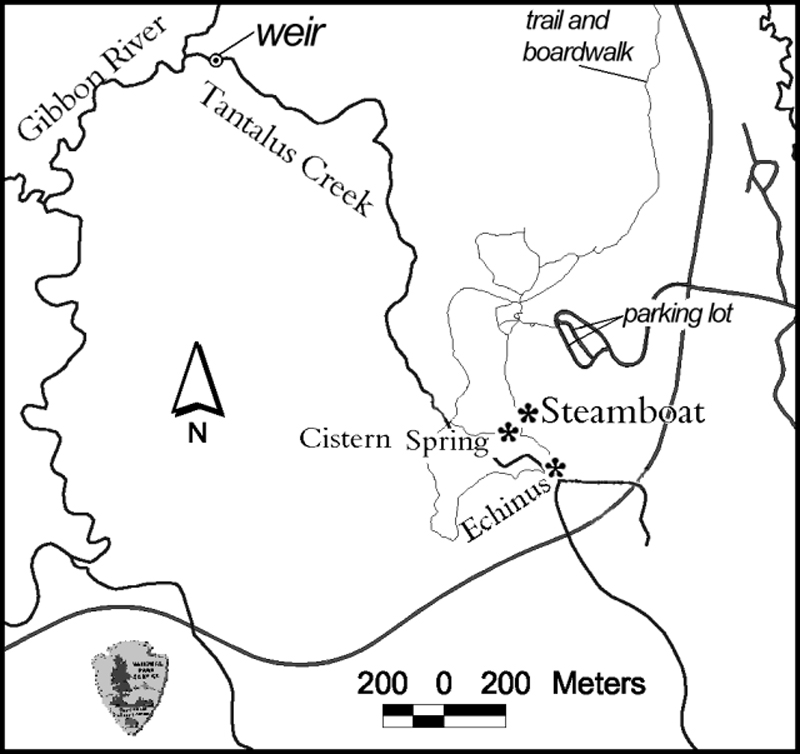 | Figure 5. A map of Yellowstone'south Norris basin showing the location of Steamboat and Echinus geysers, and Cistern Spring. The map also illustrates the parking lot where the campers spent the night of 1-two May 2000, and the location of the instrumented weir used to guess the runoff from Steamboat geyser's abnormally large discharge on two May. The map was provided by the Spatial Assay Eye, Yellowstone National Park. |
By 0700 when Lindstrom arrived, a wet mist enveloped virtually of the area effectually Steamboat geyser; it appeared as local rainfall, fifty-fifty though elsewhere the sky remained blue. The subfreezing air temperature caused ice to grade where water vicious on the boardwalks running out to the geysers. Discharging steam emitted a jet-engine-like roar. Steamboat was in full steam stage, with a vapor plumage then approximately 150 m alpine. Although the campers took early photos non yet available to the Park, other photos were taken during the steam stage of the outburst (figure 6). The loud roaring associated with the steam stage continued unabated through at least 0800 and other sources said noises remained audible at 1100 on 2 May. According to Paul Strasser, the outburst left rocks and sand on atop the bridge over the eastern runoff aqueduct at the base of the loma.
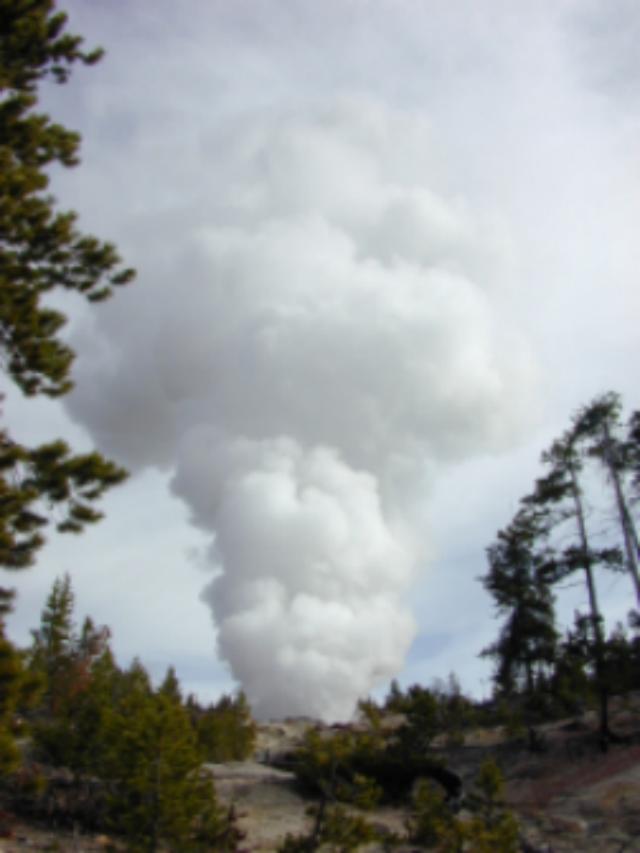 | Figure 6. A photo showing the steam-dominated secondary phase of the large 2 May discharge from Yellowstone's Steamboat geyser. More than photos of the steam stage are available at the web site given below. The verbal time of the photo and the location of the lensman remain unreported. National Park Service photo by Tom Cawley. |
Water runoff. To study changes in the Norris basin, for the by 12 years Irving Friedman has monitored the output of a small creek that drains the basin, ~2 km from Steamboat and Echinus geysers (Tantalus creek, figure 5). His efforts have been substantively aided by NPS back up and collaboration in addition to help from a cadre of volunteers.
Tantalus creek'southward discharge gets measured at a small dam with a notch of known dimension (a weir). The top of the water passing through the weir relates to the stream discharge. The water peak gets measured by a bladder gauge similar to those in auto fuel tanks. The float's position gets recorded every x minutes past a information logger. The 10-minute sampling rate means that the instrumentation can only be expected to reflect beliefs with periods over 20 minutes; signal processing theory suggests shorter processes can be aliased (i.due east., biased leading to misleading results). Since each of the outburst's two phases each lasted over an hr, the sampling interval appears to accept been adequate to describe the two phases.
Equally shown on figure seven, the 1 and 2 May weir data show runoff changing in a long-menses cycle somewhat over twenty hours in length, with the Steamboat acme on two May superimposed on or near the peak of this long-catamenia cycle. Similar long-period runoff cycles occur often in the weir data, simply their crusade has not been identified.
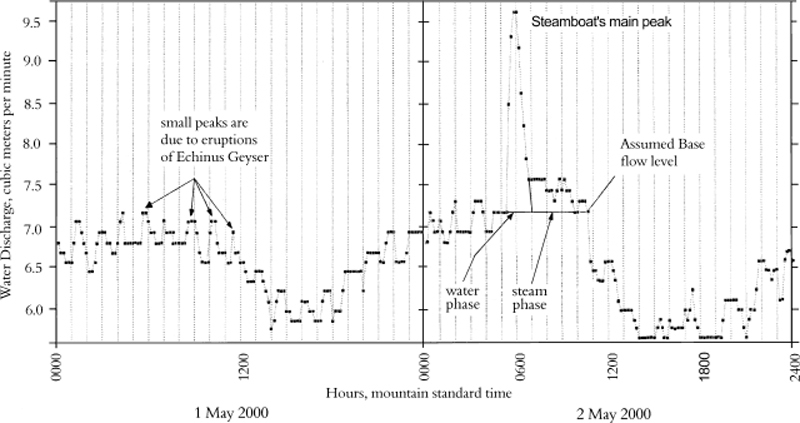 | Figure 7. A plot showing the time-series of water belch from Yellowstone's Norris bowl on 1 and ii May as measured at the weir. The position of the weir's float gauge was recorded every ten minutes. Courtesy of Irving Friedman. |
The weir data on 1 May and during parts of ii May showed the typical behavior seen in the basin, in this case with Echinus runoff producing repeated peaks with a range of 0.5-1.7 hours and a hateful of ~1.1 hours. Ignoring the interval where the Echinus data became masked by the much larger Steamboat peak, the weir information on ii May was similarly dominated by Echinus runoff; in this case showing peaks with a range of 0.5-iii hours and a mean of ~ane.one hours.
The strong 2 May discharge at Steamboat furnished runoff that arrived at the weir at about 0520 (figure 7). Friedman estimated that the travel time for water from Steamboat to the measuring weir to be most 20 to 30 minutes, so the outburst must have occurred at nearly 0500. Within the limitations of the instrumental information at the weir, the discharge reached its apex at 0600.
The water phase of the flare-up lasted twoscore to 60 minutes, reaching a recorded top discharge rate of ~10 grand3 per minute.
The total amount of h2o discharged during the outburst can be calculated, giving a minimum estimate of the belch during the outburst. The calculation was fabricated using the surface area nether the curve from the assumed base flow (figure 7).
In addition, figure 7 shows how Friedman broke the Steamboat outburst into a water-dominated phase and a later steam-dominated phase. For the water phase, the weir discharged ~150 m3 (150,000 Liters); for the steam-phase, ~36 grand3 (36,000 ,. In add-on to the measured runoff, a large, only unknown corporeality of steam and condensate escaped into the atmosphere; other losses included water stored in places such as soil, ponded on the surface, etc.
Friedman as well discusses several representative twenty-four hours-long intervals of weir information, such as 21 September 1998, a mean solar day when small-scale but regular peaks of ~0.4 m3/s occurred almost hourly, caused past the outbursts at Echinus geyser. Similar, though less regular patterns persisted in some of the later information. Unfortunately, an electric connection corroded and broke electrical continuity, halting data collection during the interval early February-May 1999.
During this interval without instrumental record, changes occurred at Norris: a) approximately i km from Echinus a new thermal area emerged; b) Echinus's period between outbursts became less regular; and c) the outbursts varied in elapsing and size, sometimes becoming absent from the tape. It is possible that this emergent thermal area robbed Echinus of some of its water and heat. How or whether this helped drive Steamboat towards its 2 May outburst remains uncertain.
Collateral observations. NPS literature states that Cistern Spring's h2o supply has been closely associated with Steamboat geyser: "When Steamboat erupts, Cistern Spring slowly drains." This blueprint prevailed in the 2 May outburst. At 1100 on 2 May the surface h2o in Cistern Spring was ~eight cm below overflow. By 1900 on two May, it had dropped past 1.ii grand. By 0900 on three May, Cistern Spring was empty; a photo around that time showed Steamboat's continuing steam stage with a plume tens of meters tall.
In reporting recent geyser news on the Geyser Observation and Study Clan (GOSA) web page, Paul Strasser noted that eight days prior to the minor outbursts, water gushed mainly from Steamboat's S vent, but occasionally gushed at its N vent, a pattern similar to the mode of activity seen last year. Strasser also noted some possible precursory effects. Afterward the outburst, visitors allegedly told NPS staff that on 29 and xxx April they had seen water from both vents reaching 12-18 m high and felt a larger burst might first.
Naturalist John Tebby told Strasser that on 1 May he saw the pocket-sized discharges starting from both of Steamboat's vents, simply only to ~2 m loftier; a pocket-size amount of runoff came from the South vent. He was only in the vicinity for a short fourth dimension. Intriguingly, Cistern Spring was so in heavy eddy to depths of fifteen-twenty cm, apparently having heated up.
Groundwork. The following comes from GOSA's descriptive list of Yellowstone's 182 geysers: "Steamboat Geyser is currently the tallest geyser in the globe. Its major eruptions [discharges] tin can soar to near 400 feet [120 m]. Unfortunately, its major eruptions [discharges] are rare and erratic. Intervals between majors have ranged from 4 days to 50 years. More common is its pocket-sized activity that consists of splashes or small discharges every few minutes. This pocket-sized play tin reach 30 feet [nine m] or more than."
"Steamboat is a cone-type geyser erupting [discharging] from two main vents. The water phase of a major eruption [outburst] lasts from 3 to twenty minutes and is followed by an extremely loud steam phase that can proceed for another 12 hours. The h2o stage emits a large amount of h2o. The aftermath of which can easily be seen around the geyser . . . [audio intensity] of the steam phase has been described as painful . . . [audible] miles away."
According to the Yellowstone Public Affairs office, Steamboat was fallow from 1911-1961. In recent years, Steamboat has had major discharges in 1989 (three events), 1990 (one event), and 1991 (one event).
Strasser discusses how during 1982-84 Steamboat produced numerous brusk-interval minor discharges, whereas during 1979 merely one flare-up took place. Strasser and others (1989) cite more than references than shown here.
References. Whittlesey, Lee, 2000, Full steam ahead: Steamboat Geyser erupts!: The Buffalo Flake (a Yellowstone National Park employee resource-management newsletter) (Jump, 2000).
Strasser, P., Strasser, S., and Pulliam, B., 1989, Investigations of patterns of small-scale behavior of Steamboat geyser, 1982-1984: Geyer Observation and Study Association Transactions, v. ii, p. 43-70 (see GOSA website).
White, D.E., Hutchinson, R.A., and Smith, T.East.C., 1988, The geology and remarkable thermal action of Norris Geyser Basin, Yellowstone National Park, Wyoming: U.S. Geological Survey Professional Paper 1456, U.S. Government Printing Function.
Information Contacts: Bob Lindstrom and Ann Rodman, Yellowstone National Park, Wyoming 82190 USA; Irving Friedman, U.S. Geological Survey, P.O. Box 25046, MS 963, Denver, CO 80225 Usa; Geyser Observation and Report Clan (GOSA), care of Janet & Udo Freund, 39237 Yellowstone St., Palmdale, CA 93551 USA (URL: http://www.geyserstudy.org/).
July 2003 (BGVN 28:07) Cite this Report
Geyser basin heats up, affecting thermal features
Yellowstone National Park printing releases indicated unusual hydrothermal activity at the Norris geyser basin in the NW-fundamental portion of the Park. A press release on 22 July 2003 announced that high ground temperatures and increased thermal activeness had resulted in the temporary closure of a portion of the Back Basin.
The press release noted "Norris is the hottest and almost seismically active geyser bowl in Yellowstone. Recent activity in the Norris geyser basin has included formation of new mud pots, an eruption of Porkchop geyser (dormant since 1989), the draining of several geysers, creating steam vents and significantly increased measured ground temperatures (upwards to 200°F [93°C]). Additional observations include vegetation dying due to thermal activity and the changing of several geysers' eruption intervals. Vixen geyser has become more frequent and Echinus geyser has become more than regular."
A press release on 7 Baronial advised of a hydrothermal monitoring program past the Yellowstone Volcano Observatory to begin at Norris geyser basin. The Observatory is a collaborative partnership between the Usa Geological Survey, the University of Utah, and Yellowstone National Park. Information technology was deploying a temporary network of seismographs, Global Positioning System receivers, and temperature loggers. Goals included identification of hydrothermal steam sources, the human relationship of the beliefs of Norris geyser basin to the general seismicity, and locating crustal deformation in the caldera.
Data Contacts: Yellowstone Volcano Observatory, a cooperative arrangement that includesRobert L. Christiansen, U.S. Geological Survey, 345 Middlefield Road, Menlo Park, CA 94025; Robert B. Smith, Department of Geology and Geophysics, University of Utah, Salt Lake City, Utah 84112 USA; Henry Heasler, National Park Service, P.O. Box 168, Yellowstone National Park, WY 82190-0168 Usa; and others (URL: https://volcanoes.usgs.gov/observatories/yvo/).
February 2006 (BGVN 31:02) Cite this Report
Low seismicity; ongoing basis-surface deformation
According to the Yellowstone Volcano Observatory (YVO), during February 2006 there was relatively low seismicity, with 82 reported earthquakes in the region. The largest of these was on 25 Feb, M iii.1, located most the N caldera rim (~ 10 km SSW of Canyon Junction). None of these earthquakes were reported as felt. Our previous report discussed elevated temperatures of the basis and increased hydrothermal effects at Norris hot springs in 2003 (BGVN 28:07). Norris also represents a frequent epicentral area for earthquakes inside the caldera. In 2002, for example, in that location were more two,350 earthquakes detected at Yellowstone, including over 500 triggered by the November 2002, M vii.9 Denali convulsion. Seismicity during April 2005-April 2006 was comparatively depression. Effigy eight plots quarterly earthquakes (≥ Chiliad ane.v) during 1974-2004 on a histogram. Figure 9 depicts earthquake swarms during 1985, 1995, and 2004.
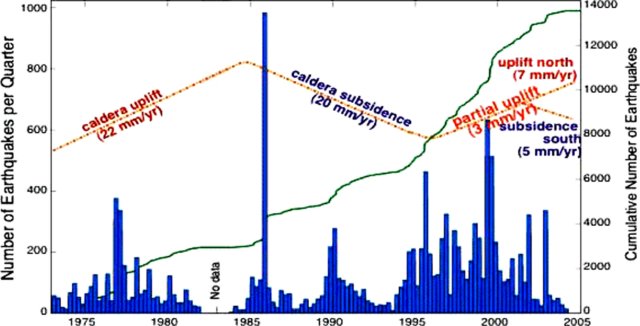 | Effigy viii. A plot of recorded earthquakes (≥ 1000 1.5) at Yellowstone from 1974 through 2004 (bars, left-manus scale: each bar represents the sum of the earthquakes of stated size per quarter (~ 90 days)). The curving solid line shows the cumulative number of earthquakes for the xxx-year menstruum (right-hand calibration). Estimates of mean caldera uplift and subsidence are shown as a dashed-and-dotted line with no scale. Note that this figure stopped in 2004 and does not depict some of the stronger deformation seen in radar and later GPS data (discussed below). Courtesy of YVO (subsequently a figure by Waite and Smith, 2002). |
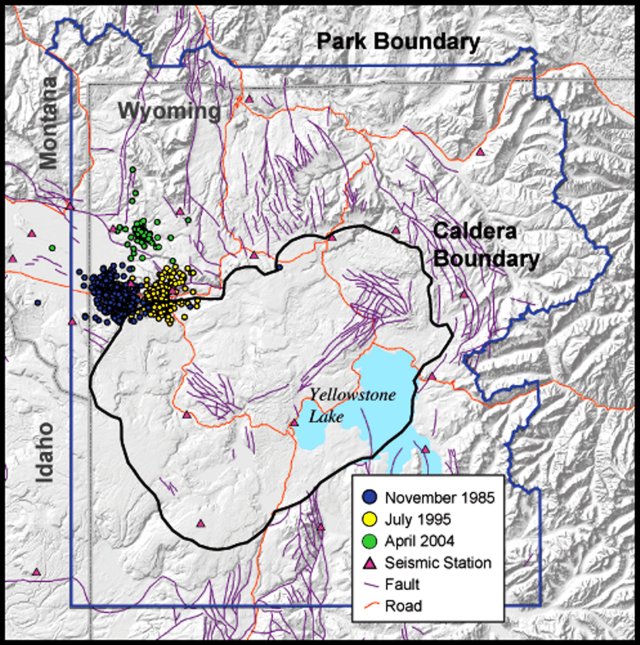 | Figure 9. A map of Yellowstone caldera and National Park with circles indicating located earthquakes (≥ M one.v) from the swarm of 1985 (westerly cluster), 1995 (easterly cluster with substantial events within the caldera), and 2004 (smaller cluster to the N of the other ii). Courtesy of YVO. |
Satellite radar created an interferogram of the caldera region (basically, a delineation of the vertical offset determined by satellite radar during 1996-2000). The interferogram portrayed vertical displacement as a big balderdash's-eye shape (figure ten), and indicated 12.5 cm of uplift centered in the northern portion of the caldera ~ 25 km NW of Yellowstone Lake.
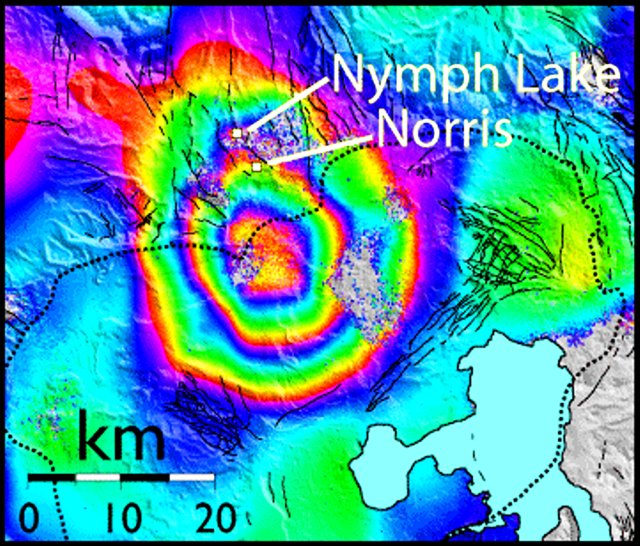 | Figure 10. A radar interferogram of the Yellowstone caldera region (after Wicks and others, 1998; 2006). This epitome of vertical ground deformation was created using data from several satellite passes during 1996 through 2000. The image shows 12.5 cm of uplift centered inside the northern end of Yellowstone caldera (blackness dotted line), about 10 km S of Norris hot springs. Each full spectrum of color (from red to regal) represents ~ 28 mm of uplift. The area of uplift is approximately 35 km x xl km in size. Courtesy of YVO-USGS. |
In response to increased oestrus and steam emissions in parts of Norris geyser bowl, a temporary, 5-station GPS network was installed in that area in 2003. The network was installed by a UNAVCO engineer, University of Utah students and faculty, and National Park Service scientists as part of a monitoring endeavour by YVO. Permanent station NRWY currently resides at that place (effigy 11).
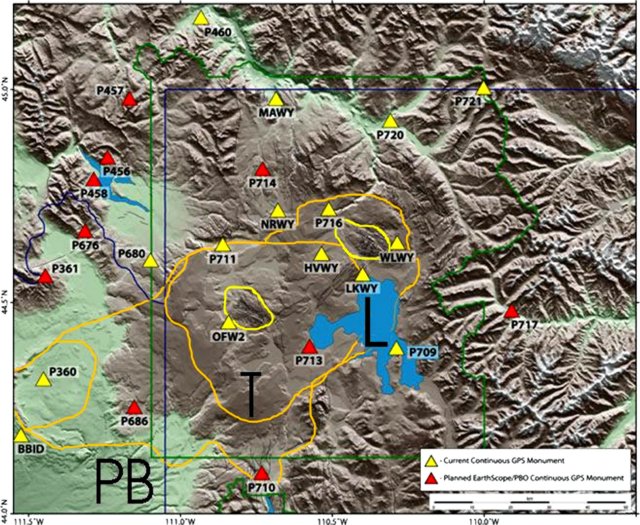 | Figure 11. GPS stations at Yellowstone caldera, including those both existing (low-cal triangles) and planned (dark triangles). The irregular loops virtually stations OFW2 and WLWY outline the 2 active resurgent domes within the 0.64 meg-twelvemonth-old Yellowstone caldera (the Mallard Lake dome and the Sour Creek dome, to the W and Due east, respectively). The effigy also includes Yellowstone caldera topographic margins (T), Yellowstone Lake (L), the National Park boundary (Pb), and some country boundaries. Courtesy of YVO-USGS. |
Movement near the Due north cease of Yellowstone Lake was measured by GPS at station LKWY during 1997 to late 2005 (effigy 12). The N-S movement (pinnacle console) shown in the past year consisted of deportation of 10-fifteen mm south. This Due north-S movement was somewhat stronger and more protracted than in the earlier parts of the GPS data. The Eastward-West motion (middle panel) was comparatively steady and unbroken over the past 6 years or more, directed westward. Over the past 9 years, the overall E-Due west motion was ~ 15 mm w. The vertical movement (lower panel) was negative (subsidence) during 1997 to mid-2004. After that, station LKWY moved sharply upward, rising ~ fourscore mm in the last year and a half. Caldera systems frequently undergo ground displacements similar to those observed at Yellowstone without progressing to eruptive action.
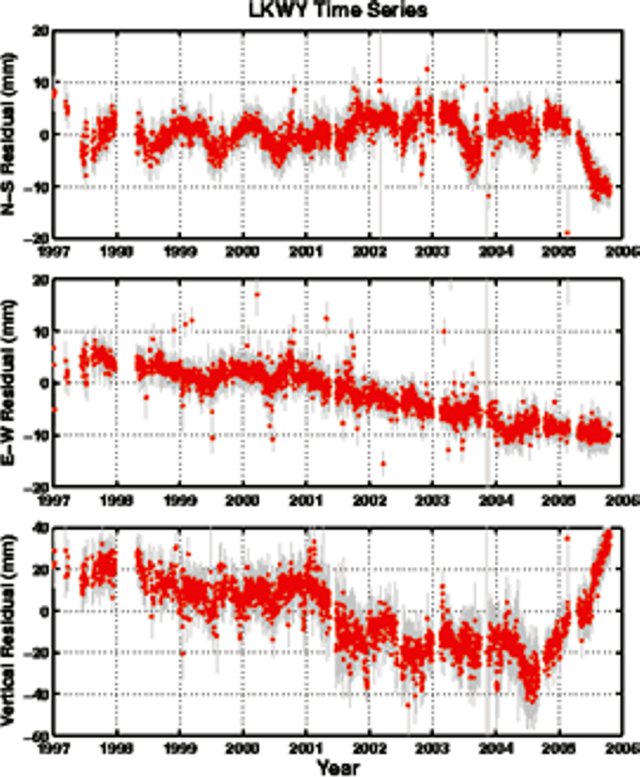 | Effigy 12. Relative movement of GPS station LKWY (located in the central office of the caldera, at the N end of Yellowstone Lake) recorded during 1997 to late 2005. The top panel shows North-Southward movement, the heart, East-W movement, and the bottom, vertical movement. During 2001-2004 station LKSY moved downwardly (subsided) on the order of 20 mm. Afterwards mid-2004, LKWY moved upward ~ 80 mm. Courtesy of YVO-USGS. |
Much of the history of older calderas that preceded Yellowstone are buried in the subsurface to the Westward, and a drilling proposal for that region is nether development. "Hotspot," the Snake River Scientific Drilling Project, announced an inter-disciplinary workshop with that goal, to be held 18-21 May 2006 and focused on issues primal to a new intermediate-depth drilling plan in the Snake River Plainly of S Idaho, USA. That region provides a tape of inferred mantle plume volcanism in an intra-continental setting. Because it is young and tectonically undisturbed, the consummate record of volcanic activity tin can be sampled only by drilling. The preliminary plan was to drill and cadre iv-half dozen holes along the axis of the East and Due west Snake River Plain.
References. Wicks, C., Thatcher, W., and Dzurisin, D., 1998, Migration of fluids beneath Yellowstone Caldera inferred from satellite radar interferometry: Scientific discipline, five. 282, p. 458-462.
Wicks, C., Thatcher, W., Dzurisin, D., and Svarc, J., 2006 (in press), Uplift, thermal unrest, and magma intrusion at Yellowstone Caldera, observed with InSAR: Nature.
Waite, G.P., and Smith, R.B.,
Information Contacts: Yellowstone Volcano Observatory, a cooperative arrangement that includesJacob B. Lowenstern, U.S. Geological Survey, 345 Middlefield Road, Menlo Park, CA 94025, Us; Robert B. Smith, Department of Geology and Geophysics, University of Utah, Salt Lake City, UT 84112, The states; Henry Heasler, National Park Service, P.O. Box 168, Yellowstone National Park, WY 82190-0168, U.s.a. (URL: http://volcanoes.usgs.gov/yvo/).
February 2010 (BGVN 35:02) Cite this Report
2nd largest recorded earthquake swarm during January-February 2010
Monthly updates from the Yellowstone Volcano Observatory (YVO) summarize seismic activity (table 1) and ground deformation at Yellowstone caldera. Earthquake action remained at low levels during the majority of the reporting interval (November 2006 through Feb 2010). There were several earthquake swarms during this time, including significant events in December 2008-January 2009 and Jan-February 2010. The early 2010 events comprised the second largest earthquake swarm recorded at Yellowstone, 2nd simply to the fall 1985 swarm (BGVN 17:03). The swarm that began in December 2008 was the third largest swarm recorded.
Table ane. Seismic data for Yellowstone organized by month, including the number of recorded earthquakes, the largest magnitude recorded, and earthquake swarm information. Notation the big swarms during December 2008-January 2009 and during January-Feb 2010. Data courtesy of the USGS.
| Calendar month | Number of earthquakes | Largest magnitude | Convulsion swarms dates (number of events) |
| Nov 2006 | 87 | two.seven on 04 Nov | 04-07 Nov (47) |
| December 2006 | 36 | 2.0 on 16 December | -- |
| Jan 2007 | 93 | 2.viii on 30 January | -- |
| Feb 2007 | 113 | two.9 on 27 Feb | 27-28 February (5); 13-22 Feb (59) |
| Mar 2007 | 63 | 2.3 on 21 Mar | 11 on 1 Mar |
| April 2007 | 53 | 2.1 on 22 Apr | -- |
| May 2007 | 59 | 2.vii on 01 May | 01 May (14) |
| Jun 2007 | 73 | i.5 on 27 Jun | twenty June (26) |
| Jul 2007 | 80 | 2.2 on 26 Jul | -- |
| Aug 2007 | 74 | ii.8 on 03 Aug | 19-21 Aug ("small-scale" event) |
| Sep 2007 | 54 | 2.3 on 10 Sep | -- |
| Oct 2007 | 34 | 2.one on 17 Oct | -- |
| Nov 2007 | 69 | 2.9 on 04 November | -- |
| Dec 2007 | 184 | 3.half-dozen on 30 Dec | 18-21 December (48) |
| Jan 2008 | 263 | iii.7 on 09 Jan | 09 Jan (124); 25-26 January (32) |
| Feb 2008 | 130 | 2.four on 03 Feb | 03 Feb (47) |
| Mar 2008 | 147 | 4.2 on 25 Mar | 11-sixteen Mar (73); 21-22 Mar (17) |
| Apr 2008 | lxx | 1.7 on 17 Apr | -- |
| May 2008 | 99 | 2.3 on 18 May | 04-fourteen May (37) |
| Jun 2008 | 79 | ii.vii on 04 Jun | 04-08 Jun (27) |
| Jul 2008 | 185 | 2.5 on 31 Jul | 28-31 Jul (132) |
| Aug 2008 | 146 | 2.iii on 31 Aug | 01-05 Aug (52); 03-07 Aug (28); 07-08 Aug (32) |
| Sep 2008 | 62 | 2.ix on 25 Sep | 25 Sep (19) |
| Oct 2008 | 46 | two.4 on 05 October | -- |
| Nov 2008 | 166 | 2.7 on 23 Nov | 23-29 Nov (77) |
| December 2008 | ~500 | three.ix on 27 Dec | 27 Dec-05 Jan (~813) |
| Jan 2009 | 315 | 3.5 on 02 Jan | 09-12 Jan (35) |
| Feb 2009 | 51 | 2.1 on xix February | -- |
| Mar 2009 | 66 | 2.4 on 03 Mar | -- |
| April 2009 | 242 | 2.7 on 28 Apr | xiii-18 April (62); 17-25 Apr (111); 29 Apr (19) |
| May 2009 | 133 | three.0 on 25 May | 25 May (68) |
| Jun 2009 | 77 | three.3 on xxx Jun | 30 Jun (25) |
| Jul 2009 | 98 | 2.7 on 08 Jul | 01-03 Jul (12) |
| Aug 2009 | 86 | two.1 on 14 Aug | 08-12 Aug (29) |
| Sep 2009 | 177 | 2.three on xx Sep | 12-17 Sep (39); thirteen-xviii Sep (66) |
| Oct 2009 | 218 | two.v on 15 Oct | 12-23 Oct (138) |
| Nov 2009 | 69 | 3.1 on 09 Nov | -- |
| Dec 2009 | 70 | two.2 on 18 December | -- |
| Jan 2010 | 1620 | three.eight on xx Jan | 17 Jan-25 February (1,809) |
| Feb 2010 | 244 | 3.1 on 02 Feb | -- |
Earthquake swarm, December 2008-Jan 2009. An earthquake swarm from 26 December 2008 to v January 2009 was centered beneath the Northward end of Yellowstone Lake. The event consisted of ~ 900 earthquakes with magnitudes ranging upwards to 3.nine; 19 events had magnitudes greater than 3.0, while 141 had magnitudes between 2.0 and 2.9.
Convulsion swarm, January-February 2010. The January-February 2010 convulsion swarm was centered about 16 km NW of Old Faithful, on the NW edge of the caldera. The upshot began with a few small earthquakes on 15 January and began to intensify on 17 January. A 3.7 magnitude earthquake was recorded at 2301 on 20 January, followed by a magnitude 3.eight event at 2316. The events were felt throughout the park and surrounding communities in Wyoming, Montana, and Idaho. Past 25 February, YVO had recorded a total of one,809 earthquakes, with 14 reaching magnitudes of over 3.0 and 136 with magnitudes between 2.0 and two.ix. By the finish of February activity had returned to background levels.
The University of Utah Seismology Research Group stated that the total seismic energy released by all the earthquakes in this swarm corresponded to one earthquake with an approximate magnitude of iv.4. YVO emphasized that while this was an unusually large event, it did non indicate premonitory volcanic or hydrothermal activeness. Rather, the swarm earthquakes were likely the result of skid on pre-existing faults.
Information Contacts: Yellowstone Volcano Observatory, U.S. Geological Survey, 345 Middlefield Road, Menlo Park, CA 94025, United states of america (URL: http://volcanoes.usgs.gov/yvo/).
Source: https://volcano.si.edu/volcano.cfm?vn=325010
0 Response to "what tectonic setting is interpreted to be the cause of volcanism at yellowstone"
Post a Comment