Can't Read on Multimeter Dc Current on Battery
Contributors: 
Measuring Voltage
To offset, let's mensurate voltage on a AA battery: Plug the blackness probe into COM and the red probe into mAVΩ. Gear up the multimeter to "2V" in the DC (direct current) range. Near all portable electronics utilize direct electric current), not alternating current. Connect the black probe to the battery's ground or '-' and the red probe to ability or '+'. Clasp the probes with a niggling pressure against the positive and negative terminals of the AA bombardment. If you've got a fresh battery, you should see around 1.5V on the display (this battery is brand new, so its voltage is slightly college than 1.5V).
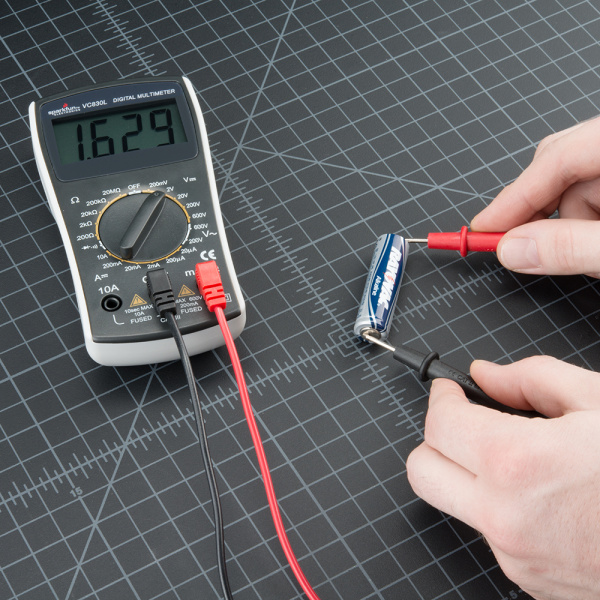
If you lot're measuring DC voltage (such as a bombardment or a sensor hooked upwards to an Arduino) yous want to set the knob where the V has a directly line. Air-conditioning voltage (like what comes out of the wall) tin exist unsafe, so we rarely demand to use the AC voltage setting (the V with a wavy line side by side to it). If you're messing with Air-conditioning, we recommend yous get a non-contact tester rather than use a digital multimeter.
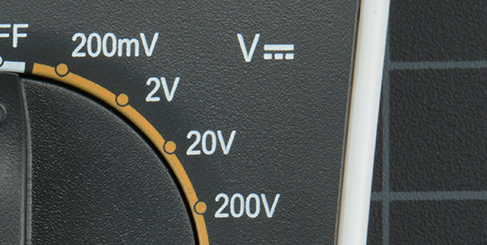
Use the V with a direct line to measure out DC Voltage
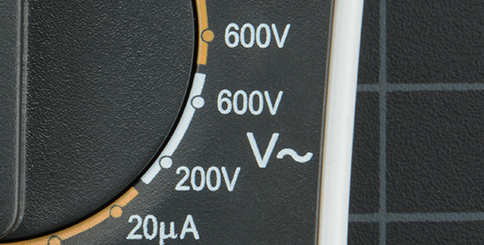
Use the Five with a wavy line to measure AC Voltage
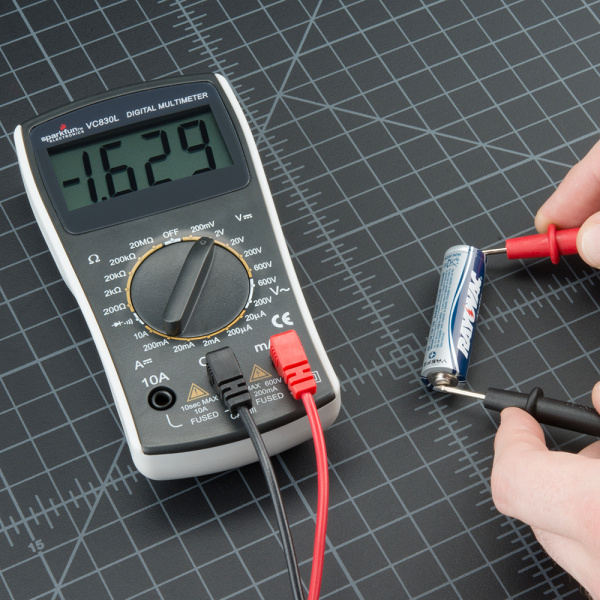
What happens if you switch the red and black probes? The reading on the multimeter is simply negative. Zip bad happens! The multimeter measures voltage in relation to the common probe. How much voltage is at that place on the '+' of the battery compared to common or the negative pin? 1.5V. If nosotros switch the probes, we define '+' every bit the common or nada point. How much voltage is at that place on the '-' of the bombardment compared to our new nada? -1.5V!
Now let's construct a simple circuit to demonstrate how to measure voltage in a real globe scenario. The circuit is but a 1kΩ and a Blue super brilliant LED powered with a SparkFun Breadboard Power Supply Stick. To begin, permit's make sure the circuit you are working on is powered upwardly correctly. If your project should be at 5V but is less than 4.5V or greater than five.5V, this would quickly give y'all an indication that something is wrong and yous may demand to check your power connections or the wiring of your circuit.
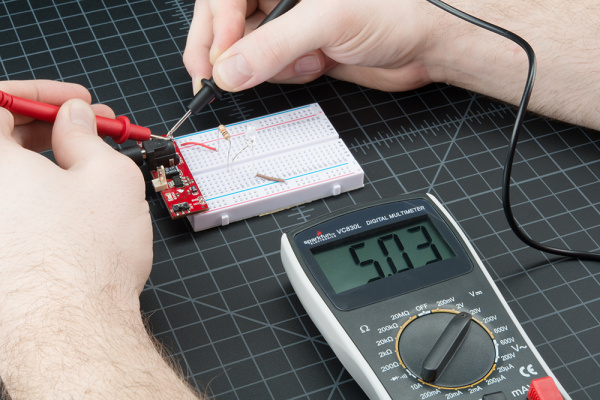
Measuring the voltage coming off of a Ability Supply Stick.
Set the knob to "20V" in the DC range (the DC Voltage range has a V with a straight line next to it). Multimeters are generally not autoranging. You have to fix the multimeter to a range that it can measure. For instance, 2V measures voltages up to two volts, and 20V measures voltages up to twenty volts. So if you've measuring a 12V battery, use the 20V setting. 5V organization? Use the 20V setting. If you set information technology incorrectly, you will probably see the meter screen change and so read '1'.
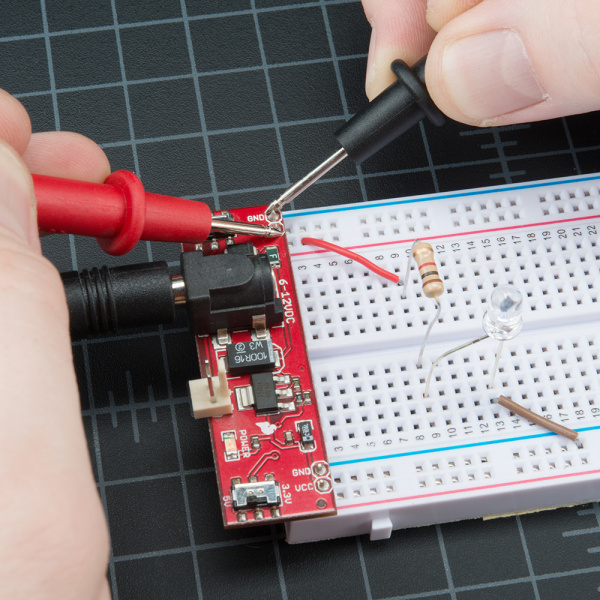
With some force (imagine poking a fork into a piece of cooked meat), push the probes onto 2 exposed pieces of metallic. One probe should contact a GND connection. One probe to the VCC or 5V connection.
Nosotros tin test different parts of the circuit as well. This practise is chosen nodal analysis, and information technology is a bones building block in circuit analysis. By measuring the voltage across the circuit we can see how much voltage each component requires. Let'due south measure out the whole circuit first. Measuring from where the voltage is going in to the resistor and and so where ground is on the LED, we should come across the total voltage of the excursion, expected to be around 5V.
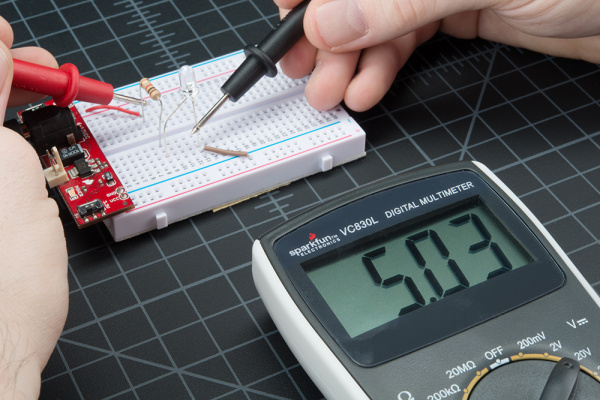
We can so see how much voltage the LED is using. This is what is referred to as the voltage drop across the LED. If that doesn't make sense at present, fear not. It will as you explore the earth of electronics more. The important matter to accept abroad is that different parts of a excursion can be measured to analyze the circuit as a whole.
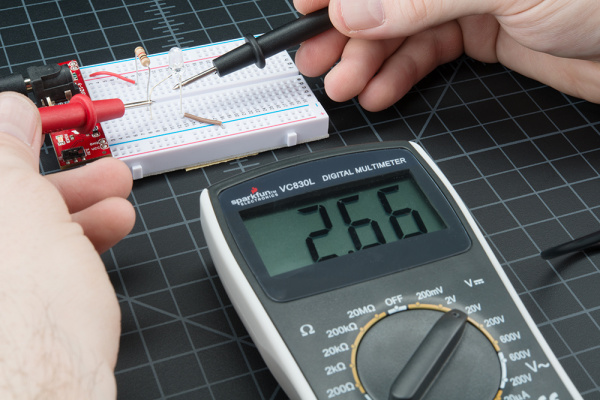
This LED is using ii.66V of the available 5V supply to illuminate. This is lower than the forward voltage stated in the datasheet on account of the excursion only having small corporeality of electric current running though it, merely more on that in a bit.
Overload
What happens if y'all select a voltage setting that is also low for the voltage you're trying to measure? Nada bad. The meter will simply display a i. This is the meter trying to tell you that it is overloaded or out-of-range. Any you lot're trying to read is too much for that detail setting. Try irresolute the multimeter knob to a the next highest setting.
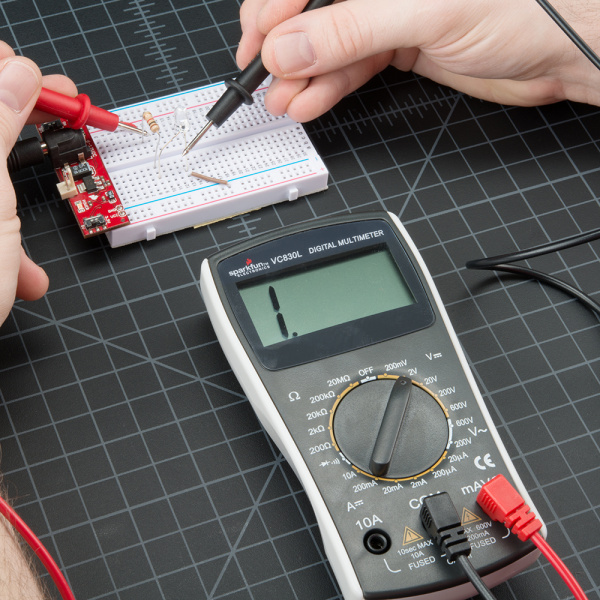
Reading the 5V across this circuit is too much for the 2V setting on the multimeter.
Selection Knob
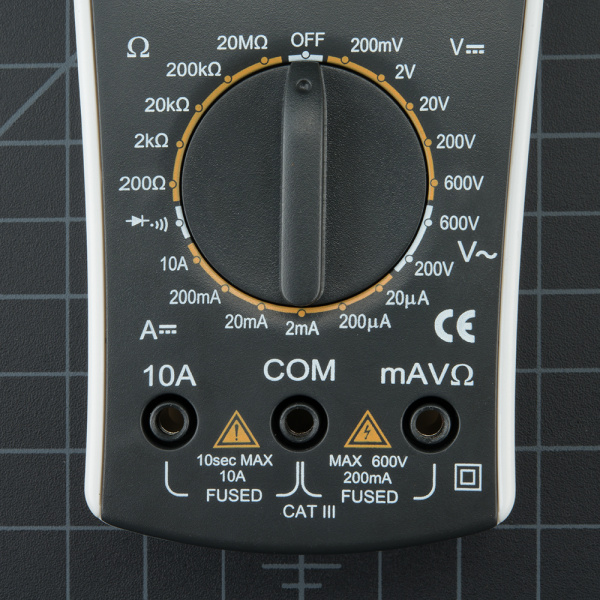
Why does the meter knob read 20V and not 10V? If you're looking to measure a voltage less than 20V, yous turn to the 20V setting. This volition allow you to read from 2.00 to 19.99.
The showtime digit on many multimeters is only able to display a '1' so the ranges are limited to 1nine.99 instead of 99.99. Hence the 20V max range instead of 99V max range.
Warning! In general, stick to DC circuits (the settings on the multimeter with directly lines, non curvy lines). Near multimeters tin measure Ac (alternating current) systems, but AC circuits tin be dangerous. A wall outlet with AC or 'primary voltage' is the stuff that tin can zap you pretty skilful. VERY carefully respect AC. If you need to check to see if an outlet is 'on' then use a AC tester. Actually the only times we've needed to measure AC are when we've got an outlet that is acting funny (is it really at 110V?), or if we're trying to control a heater (such as a hot plate). Go irksome and double cheque everything before you exam an Air-conditioning excursion.
Source: https://learn.sparkfun.com/tutorials/how-to-use-a-multimeter/measuring-voltage
0 Response to "Can't Read on Multimeter Dc Current on Battery"
Post a Comment