What Is the Cause Baby Doesn't Sleep Enough
Is there such a thing as "baby sleep deprivation" ?
It's clear that babies can crusade sleep deprivation in others. But whether or not babies themselves suffer from sleeplessness is less clear. In my search for published studies most infants with indisposition, I've come up up with well-nigh zippo.
Researchers acknowledge all sorts of infant sleep problems, including difficulty settling, too-frequent dark wakings, sleep-disordered animate, and medical conditions that can interfere with sleep, like GERD. You can read more well-nigh it in opens in a new windowthis Parenting Science guide.
Researchers also recognize the existence of something chosen "behavioral insomnia" in young children. Behavioral insomnia" refers to issues caused by a kid's refusal to go to bed, or by a kid's dependence on lengthy or elaborate caregiving in order to autumn comatose at nighttime (Mindell et al 2006).
But — to engagement — I haven't found any scientific descriptions of chronic slumber restriction in babies.
Maybe that's a proficient thing, bear witness that sleeplessness in babies is very rare. If yous take an evolutionary perspective — and consider how many babies have learned to slumber in slings while their parents went about their daily chores — this seems quite plausible. Babies may be able to regulate their own slumber needs very well, even amidst hustle and bustle.
Nevertheless, you may accept questions. How much sleep does your baby demand? How can you tell if your infant isn't getting plenty sleep? And does chronic sleep loss during infancy have any long-term effects?
Here I review what the available evidence tells united states of america.
How much sleep does a baby really need?
Babies vary substantially in the amount of sleep that they need, particularly during the first yr postpartum.
For example, more than than half of all 6-month-olds go at least 12 hours of sleep each day. Yet a sizeable pct of babies — who appear to be otherwise healthy — sleep substantially less. So just sleeping less-than-average doesn't hateful your baby has a trouble (Paavonen et al 2020).
This Parenting Science article about the opens in a new windownormal range of sleep times in infants may help put your concerns about baby slumber deprivation in perspective.
Still, information technology's possible for things to go wrong, fifty-fifty if your infant's total sleep time falls within this broad range of normal variation.
For instance, your infant may accept a long time to fall comatose at night, or wake upwards more ofttimes than most other babies practice. Is this evidence of a trouble? Is it something yous can improve?
As I explain elsewhere, there are many ecology factors that can contribute to bedtime resistance and frequent night wakings. Read more nearly these factors — and how to fix them — in this problem-shooting guide.
And whether your baby resists bedtime, or wakes upwardly very frequently, you lot may wonder about our baby's personal sleep requirements.
Some babies log as petty as 9-10 hours of total slumber fourth dimension each day, and don't appear to suffer from whatsoever health problems. But should we presume that all babies sleeping this little are receiving the optimal corporeality of sleep? No, we shouldn't.
So how tin yous tell if a baby isn't getting enough sleep?
Pediatricians and experienced parents have noted these signs of "over-tiredness" in the very young:
- A noted lack of interest in people and the environment
- A tendency to look abroad from stimulating things
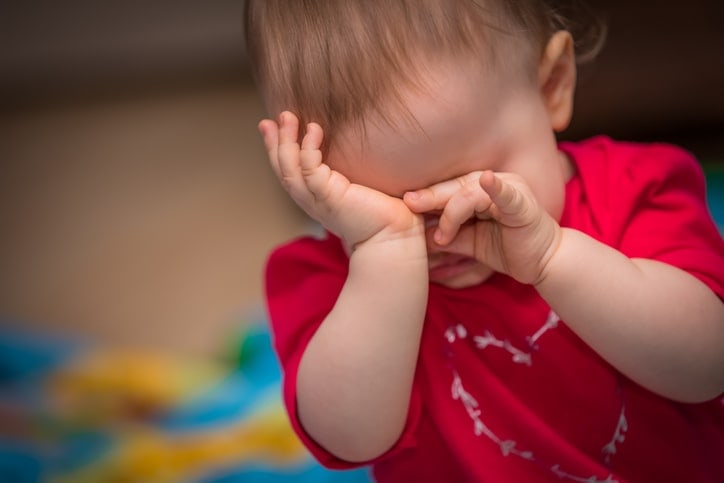
- Hand-to-face gestures: Pulling ears, rubbing optics
- Fluttering eyelids
- Yawning

For older babies and toddlers, signs may likewise include:
- Becoming more accident-prone
- Becoming more "clingy"
- Becoming e'er-more active equally the night wears on
I've besides culled several markers of sleep deprivation from the scientific literature:
- Poor recovery from negative emotions
- Feeding troubles
- Being hard to awaken
- Having a lower threshold for hurting
Let'due south take these up in particular.
Poor recovery from negative emotions as a sign of baby sleep deprivation
I'm sure y'all've experienced information technology yourself: Running short on sleep makes it harder to bounce back from negative emotions.
We become moodier and more impulsive when we're sleep-deprived. We accept more trouble interpreting the emotions of others, and nosotros're more probable to perceive neutral stimuli as threatening (Ben Simon et al 2020).
These difficulties take been documented in preschoolers equally well as adults (Lassonde et al 2016; Berger et al 2012). Just what about babies? They, besides seem to exist affected.
In an experimental study, researchers deliberately disrupted the sleep of fourteen-month-old babies during a unmarried laboratory "sleepover." The following 24-hour interval, these babies showed poorer "emotional regulation," i.e., they had difficulty recovering from negative emotions (Montgomery-Downs and Gozal 2006).
Sleep problems are linked with feeding problems
Researchers studying over 600 American babies, aged 6-36 months, found that babies with feeding difficulties (e.yard., refusing to eat) fell asleep afterwards at night and slept for shorter intervals. They were also more likely exist diagnosed with "behavioral indisposition" (Tauman et al 2011).
Does a lack of sleep cause feeding problems? Do feeding bug crusade sleep loss? Or do these troubles get together for some other reason?
We tin't know the answer from this study. It reports correlations only. But in a follow-up report, researchers found that both types of trouble tend to make parents feel more distressed (Golik et al 2013), and parental distress can fuel sleep problems.
Slumber-deprived babies accept more difficulty awakening
Inquiry suggests that sleep-deprived adults spend more time in deep sleep, a land characterized by fewer arousals and greater difficultly awakening.
Babies appear to fit this pattern as well.
For example, in an experiment on 8-week-old infants, researchers subjected babies to brief episodes of sleep deprivation, and then attempted to awaken them with blasts of white racket.
Compared to their responses during a (non-sleep-deprived) command condition, the babies required louder noises earlier enkindling (Franco et al 2004).
An earlier study of three-month old infants yielded like results (Thomas et al 1996).
Is this reason for concern? I think then.
Another experiment found that babies subjected to short-term sleep impecuniousness experienced more sleep-disordered breathing, including obstructive sleep apnea (Canet et al 1985).
Obstructive sleep apnea has been linked with a diversity of wellness issues (Jennum et al 2013), and an increased risk of SIDS.
Sleep restriction may make babies more sensitive to hurting
Controlled experiments confirm that chronic sleep restriction tin can lower our thresholds for pain.
For example, an experiment on immature adults found that people became more sensitive to painful stimuli after spending iii weeks on a sleep-restricted schedule. These report volunteers — who were permitted to sleep merely 4 hours on weekdays — as well reported more than frequent, spontaneous aches and pains, including headaches, dorsum pain, and muscle aches (Simpson et al 2019).
Do sleep-deprived babies experience like effects? I don't believe anybody has ever tested this on human infants (and perhaps they never will, given the obvious ethical considerations).
Yet, a recent experiment on infant mice is concerning.
When the mice were newborns, researchers restricted their total slumber past two hours each day. The treatment lasted for ten days, after which the mice were free to sleep usually. Later on — when the mice where adolescents — researchers tested their responses to pain by placing them on a hot plate.
Compared to peers in a control group, the mice who'd experienced babe sleep restriction exhibited a lower tolerance for pain. Their threshold for estrus pain was nearly 25% lower (Araujo et al 2018).
What does this mean? Mice aren't humans, and it's skilful to know that the increased sensitivity to pain wore off past the time the mice were adults.
Just, in combination with the research on human being adults, this study lends weight to the idea that infant sleep loss could shape the class of development.
What well-nigh other long-term outcomes? Does chronic slumber loss during infancy crusade bug later on?
There is some evidence for the thought. We've already noted that short-term slumber loss affects a infant's emotional responses. And a contempo written report hints that chronic short slumber might be a risk gene for developing self-regulation problems. Children who slept less than their peers at the age of 3 months were more likely to experience cocky-regulation deficits at the age of 24 months (Morales-Munoz et al 2020).
Where might this tendency lead? A young child who is irritable or overreactive will tend to provoke negative responses from other people. And this could make it harder for the child to develop positive social relationships, and acquire social skills.
In back up of this idea, a report of preschoolers plant that kids who slept less were less likely to exist accepted by their peers. They tended to accept poorer social skills and smaller receptive vocabularies. They likewise showed a weaker agreement of the causes of emotions (Vaughn et al 2015).
And then nosotros shouldn't dominion out the possibility that chronic slumber loss, starting in infancy, could contribute to the development of behavior problems.
And today's researchers speculate that early life slumber loss may affect the growth of myelin, the white matter in the encephalon that insulates our neurons (LeBourgeois et al 2019; Kurth et al 2016).
What's the takeaway?
If yous suspect your infant is routinely overtired and seems unusually hard to awaken, information technology's worth discussing your concerns with your medical provider. He or she may want to screen your baby for signs of irregular breathing or slumber apnea.
If your kid likewise has feeding problems, or seems to have difficulty handling disappointments, frustrations, and other negative emotions, you might exist coping with a parcel of troubles that frequently get together. While researchers haven't withal established the root cause of these interrelated troubles, it makes sense for concerned parents to take some common-sense steps:
- Talk with your physician about your infant'due south symptoms. Is at that place reason to think a medical condition might exist interfering with her slumber?
- Learn about the behavioral adjustments you can make to foster the development of more mature sleep patterns. This opens in a new windowParenting Science commodity nearly baby sleep problems tin help.
- Prove sensitivity to your baby'south emotions and insecurities at bedtime. Parents who do so report fewer sleep problems (Teti et al 2010)
- Watch out for your own negative emotions. Caring for a seemingly sleepless infant is stressful. But if your babe detects your distress, your may become even more restless, creating a roughshod circle. Here is some opens in a new windowParenting Science advice for soothing a stressed-out infant, every bit well as my opens in a new windowevidence-based tips for handling your own stress.
More Parenting Science manufactures about baby sleep
- opens in a new window15 baby sleep tips: A guide for the scientific discipline-minded parent
- opens in a new windowBabe sleep requirements
- opens in a new windowBaby slumber patterns: An evidence-based guide
- opens in a new windowDream feeding: An evidence-based guide to helping babies sleep longer
- opens in a new windowNight wakings: A guide for the science-minded
References: Infant sleep deprivation
Alfano CA, Bower JL, Harvey AG, Beidel DC, Sharp C, Palmer CA. 2020. Slumber restriction alters children's positive emotional responses, just furnishings are moderated by anxiety. J Child Psychol Psychiatry. 2020 Jul 4. doi: 10.1111/jcpp.13287. Online ahead of print.
Anders TF. 2003. Slumber-wake states and issues and kid psychosocial development. In: RE Tremblay, RG Barr, and RDeV Peters (eds). Encylopedia on Early Childhood Development [online]. Montreal, Quebec: Centre of Excellence for Early on Childhood Development 2003: ane-six. Bachelor at http//www.child encyclopedia.com/documents/AndersANGxp.pdf. Accessed i.half-dozen.08.
Ben Simon E, Vallat R, Barnes CM, Walker MP. 2020. Sleep Loss and the Socio-Emotional Brain. Trends Cogn Sci. 24(6):435-450.
Berger RH, Miller AL, Seifer R, Cares SR, LeBourgeois MK. 2012. Acute sleep brake effects on emotion responses in 30- to 36-month-old children. J Sleep Res. 21(three):235-46
Bolten MI. 2012. Baby psychiatric disorders. Eur Child Adolesc Psychiatry. 22 Suppl 1:S69-74.
Canet Due east, Gaultier C, D'Allest AM, and Dehan M. 1989. Effects of slumber deprivation on respiratory events during slumber in healthy infants. J Appl Physiol. 66(3):1158-63.
El-Sheikh M, Philbrook LE, Kelly RJ, Hinnant JB, Buckhalt JA. 2019. What does a good night'south sleep hateful? Nonlinear relations between sleep and children'southward cerebral operation and mental health. Sleep. 42(6):zsz078.
Franco P, Seret N, Van Hees JN, Scaillet Southward, Vermeulen F, Grosswasser J, and Kahn A. 2004. Decreased arousals among healthy infants afterwards brusque-term sleep deprivation. Pediatrics 114: 192-197.
Jenni OG, Borbely AA, and Achermann P. 2004. Development of the Nocturnal Sleep Electroencephalogram In Human being Infants. Journal of Physiology – Regulatory, Integrative and Comparative Physiology 286: R528-R538.
Jennum P, Ibsen R, and Kjellberg J. 2013. Morbidity and mortality in children with obstructive slumber apnoea: a controlled national report. Thorax. 68(10):949-54.
Kuhn BR, Mayfield JW, and Kuhn RI. 1999. Clinical assessment of child and adolescent slumber disturbance. Periodical of Counseling and Development 77: 359-368.
Kurth Due south, Dean DC 3rd, Achermann P, O'Muircheartaigh J, Huber R, Deoni SC, LeBourgeois MK. 2016. Increased Sleep Depth in Developing Neural Networks: New Insights from Sleep Restriction in Children. Forepart Hum Neurosci. 10:456.
Lassonde JM, Rusterholz T, Kurth S, Schumacher AM, Achermann P, LeBourgeois MK. 2016. Slumber Physiology in Toddlers: Effects of Missing a Nap on Subsequent Night Sleep. Version 2. Neurobiol Sleep Circadian Rhythms. one(i):19-26.
LeBourgeois MK, Dean DC, Deoni SCL, Kohler Thousand, Kurth Due south. 2019. A unproblematic sleep EEG marker in childhood predicts brain myelin 3.v years later. Neuroimage. 199:342-350.
Mindell JA, Kuhn B, Lewin DS, Meltzer LJ, Sadeh A;. 2006. Behavioral handling of bedtime problems and night wakings in infants and young children. American Academy of Sleep Medicine. Slumber 29(10):1263-76.
Montgomery-Downs HE and Gozal D. 2006. Toddler behavior following polysomnography: effects of unintended sleep disturbance. Sleep 29: 1282-1287.
Morales-Muñoz I, Lemola S, Saarenpää-Heikkilä O, Kylliäinen A, Pölkki P, Paunio T, Broome MR, Paavonen EJ. 2020. Parent-reported early slumber problems and internalising, externalising and dysregulation symptoms in toddlers. BMJ Paediatr Open. 4(1):e000622.
Mullins EN, Miller AL, Cherian SS, Lumeng JC, Wright KP Jr, Kurth South, Lebourgeois MK. 2017. Acute sleep restriction increases dietary intake in preschool-age children. J Sleep Res. 2017 Feb;26(1):48-54.
Paavonen EJ, Saarenpää-Heikkilä O, Morales-Munoz I, Virta M, Häkälä Northward, Pölkki P, Kylliäinen A, Karlsson H, Paunio T, Karlsson L. 2020. Normal sleep development in infants: findings from 2 large nascency cohorts. Sleep Med. 69:145-154.
Simpson NS, Scott-Sutherland J, Gautam S, Sethna N, Haack 1000. 2018. Chronic exposure to insufficient sleep alters processes of pain habituation and sensitization. Pain. 159(1):33-40
Teti DM, Kim BR, Mayer Thou, and Countermine M. 2010. opens in a new windowMaternal emotional availability at bedtime predicts infant slumber quality. J Fam Psychol. 24(3):307-15
Tauman R, Levine A, Avni H, Nehama H, Greenfeld M, Sivan Y. 2011. Coexistence of sleep and feeding disturbances in young children. Pediatrics. 127(iii):e615-21.
Thomas DA, Poole One thousand, McArdle EK, Goodenough PC, Thompson J, Beardsmore CS, and Simpson H. 1996. The effect of sleep deprivation on sleep states, breathing events, peripheral chemoresponsiveness and arousal propensity in healthy 2 month old infants. European Respiratory Journal nine: 932-938.
Vaughn BE, Elmore-Staton L, Shin Due north, El-Sheikh M. 2015. Sleep as a support for social competence, peer relations, and cognitive functioning in preschool children. Behav Slumber Med. 13(2):92-106.
Vriend JL, Davidson FD, Corkum PV, Rusak B, Chambers CT, McLaughlin EN. 2013. Manipulating sleep duration alters emotional functioning and cognitive functioning in children. J Pediatr Psychol. 38(10):1058-69.
"Baby sleep deprivation" last modified 7/2020
This is an update of a Parenting Scientific discipline previously published under the aforementioned championship; portions of text derive from a version final modified in 2014.
Image credits for "Infant sleep deprivation: How to tell if your baby isn't getting enough sleep"
Title image past NikonShutterman / istock
Image of tired child in stroller by Kyryl Gorlov / istock
Source: https://parentingscience.com/baby-sleep-deprivation/
0 Response to "What Is the Cause Baby Doesn't Sleep Enough"
Post a Comment