The Nurse Is Reviewing to Physician Prescription for a Child Hospitalized With Nephrotic Syndrome
Nephrotic syndrome, or nephrosis, is defined by the presence of nephrotic-range proteinuria, edema, hyperlipidemia, and hypoalbuminemia.
What is Nephrotic Syndrome?
Nephrotic syndrome has a course of remissions and exacerbations that usually lasts for months.
- Nephrotic syndrome, or nephrosis, is defined by the presence of nephrotic-range proteinuria, edema, hyperlipidemia, and hypoalbuminemia.
- While nephrotic-range proteinuria in adults is characterized by poly peptide excretion of 3.five g or more than per day, in children it is divers as protein excretion of more than than 40 mg/thou2/h or a first-morning urine protein/creatinine of 2-3 mg/mg creatinine or greater.
Pathophysiology
In a healthy private, less than 0.1% of plasma albumin may traverse the glomerular filtration barrier. Amounts to a higher place 500 mg/twenty-four hour period signal to glomerular illness.
- The glomerular capillaries are lined past a fenestrated endothelium that sits on the glomerular basement membrane, which in turn is covered past glomerular epithelium, or podocytes, which envelops the capillaries with cellular extensions chosen foot processes.
- In between the foot processes are the filtration slits; these three structures—the fenestrated endothelium, glomerular basement membrane, and glomerular epithelium—are the glomerular filtration barrier.
- Filtration of plasma water and solutes is extracellular and occurs through the endothelial fenestrae and filtration slits.
- The importance of the podocytes and the filtration slits is shown by genetic diseases: in built nephrotic syndrome of the Finnish type, the gene for nephrin, a protein of the filtration slit, is mutated, leading to nephrotic syndrome in infancy; similarly, podocin, a protein of the podocytes, may be abnormal in a number of children with steroid-resistant focal glomerulosclerosis.
- The glomerular structural changes that may cause proteinuria are damage to the endothelial surface, the glomerular basement membrane, or the podocytes; one or more than of these mechanisms may be seen in whatsoever one type of nephrotic syndrome.
- Albuminuria lone may occur or, with greater injury, leakage of all plasma proteins (ie, proteinuria) may have place.
- There are 2 current hypotheses for the formation of edema in nephrotic syndrome: the underfill hypothesis holds that the loss of albumin leading to lower plasma colloid pressure is the crusade; the overfill hypothesis states that the edema is due to main renal sodium retention.
Statistics and Incidences
Nephrotic syndrome is present in as many as vii children per 100, 000 population younger than 9 years of age.
- The boilerplate historic period of onset is 2.5 years, with about cases occurring betwixt the ages of 2 and half-dozen years.
- In the United States, the reported annual incidence rate of nephrotic syndrome is 2-7 cases per 100,000 children younger than sixteen years.
- In children younger than eight years at onset, the ratio of males to females varies from 2:1 to 3:ii in various studies.
- In children, nephrotic syndrome may occur at a rate of twenty cases per million children.
- Because diabetes is major cause of nephrotic syndrome, American Indians, Hispanics, and African Americans have a higher incidence of nephrotic syndrome than do white persons.
- There is a male predominance in the occurrence of nephrotic syndrome, as for chronic kidney illness in general.
Causes
In that location are two causes of nephrotic syndrome: main and secondary.
- Main. Common main causes of nephrotic syndrome include kidney diseases such every bit minimal-change nephropathy, membranous nephropathy, and focal glomerulosclerosis.
- Secondary. Secondary causes include systemic diseases such as diabetes mellitus, lupus erythematosus, and amyloidosis.
Clinical Manifestations
The commencement sign of nephrotic syndrome in children is usually swelling of the face up; this is followed by swelling of the entire body.
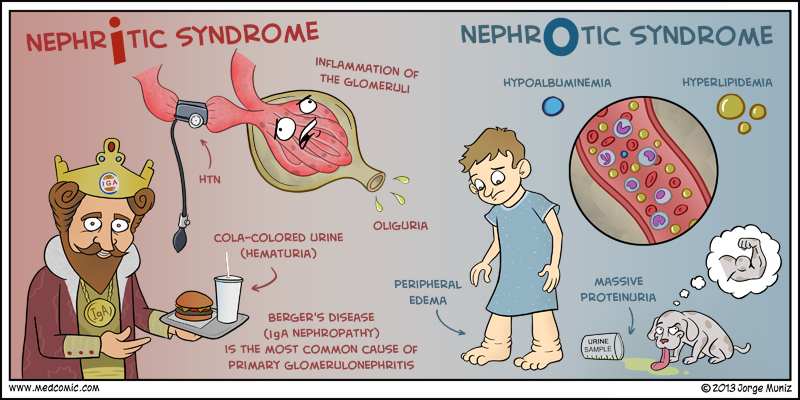
- Edema. Edema is the salient characteristic of nephrotic syndrome and initially develops effectually the eyes and legs; with time, the edema becomes generalized and may be associated with an increase in weight, the development of ascites, or pleural effusions.
- Malnutrition. Malnutrition may become severe, nonetheless, the generalized edema masks the loss of trunk tissue, causing the child to nowadays a chubby appearance and to double his or her weight.
- Irritability and loss of appetite. Anorexia, irritability, and loss of appetite develop.
- Immunosuppression. These children are more often than not susceptible to infection, and repeated acute respiratory weather are the usual blueprint.
- Proteinuria. Albumin leaks out due to structural damage, leading to proteinuria.
- Respiratory tract infection. A history of a respiratory tract infection immediately preceding the onset of nephrotic syndrome is frequent.
- Allergy. Approximately 30% of children with nephrotic syndrome accept a history of allergy.
Assessment and Diagnostic Findings
In order to establish the presence of nephrotic syndrome, laboratory tests should confirm (1) nephrotic-range proteinuria, (2) hypoalbuminemia, and (iii) hyperlipidemia. Therefore, initial laboratory testing should include the following:
- Urine studies. First morning urine protein/creatinine is more easily obtained than 24-hour urine studies, is possibly more reliable, and excludes orthostatic proteinuria; a urine poly peptide/creatinine ratio of more than 2-3 mg/mg is consistent with nephrotic-range proteinuria.
- Blood studies. Serum albumin levels in nephrotic syndrome are generally less than 2.five one thousand/dL; serum sodium levels are low in patients with INS because of hyperlipidemia (pseudohyponatremia), too as dilution due to water retention; on the CBC, an increased hemoglobin and hematocrit indicate hemoconcentration and intravascular volume depletion; the platelet count is often increased.
- Genetic testing. Patients with infantile or congenital nephrotic syndrome should take testing for mutations in NPHS1 and WT1; if test results are normal, then testing for mutations in NPHS2 and PLCE1 should exist considered.
Medical Management
The management of nephrotic syndrome is a long process with remissions and recurrence of symptoms mutual.
- Corticosteroid therapy. The general consensus now is daily induction steroid treatment for 6 weeks, followed past alternate-day maintenance therapy for another 6 weeks.
- Diuretic therapy. Diuretic therapy may exist beneficial, particularly in children with symptomatic edema; loop diuretics, such equally furosemide (starting at 1-2 mg/kg/d) may improve edema; their assistants, however, should be handled with intendance considering plasma volume contraction may already be present, and hypovolemic shock has been observed with overly aggressive therapy.
- Abode monitoring. Habitation monitoring of urine protein and fluid condition is an of import aspect of management; all patients and parents should be trained to monitor first forenoon urine proteins at abode with urine dipstick; urine testing at home is also useful in monitoring response (or non-response) to steroid treatment.
- Nutrition. A sodium-restricted diet should be maintained while a patient is edematous and until proteinuria remits; during severe edema, careful and small fluid restriction may be appropriate, only the patient must be monitored closely for excessive intravascular volume depletion.
- Activity. A normal activity plan is recommended.
Pharmacologic Direction
Prednisone is the outset-line therapy for children with nephrotic syndrome. Other immunosuppressive medications may be useful in those whose symptoms fail to answer to standard corticosteroid therapy or in those who have frequent relapses.
- Glucocorticoids. All glucocorticoids are effective; however, prednisone or prednisolone is used nigh commonly; their specific mode of action in nephrotic syndrome is unknown.
- Diuretics. Diuretics promote excretion of water and electrolytes by the kidneys; these agents are used to care for middle failure or hepatic, renal, or pulmonary disease when sodium and water retention has resulted in edema or ascites.
- Plasma protein. This amanuensis is used to supplement diuresis in patients with edema; it increases oncotic pressure and thereby promotes a fluid shift from interstitial tissues.
- Immunosuppressive agents. This amanuensis is used to supplement diuresis in patients with edema; it increases oncotic pressure and thereby promotes a fluid shift from interstitial tissues.
Nursing Direction
The nursing management of a child with nephrotic syndrome include the following:
Nursing Assessment
Assess for the following:
- Edema. Notice for edema when performing physical examination of the child with nephrotic syndrome.
- Weigh and mensurate. Weigh the child and record the abdominal measurements to serve equally a baseline.
- Vital signs. Obtain vital signs, including blood pressure.
- Pitting edema. Note any swelling about the optics or the ankles and other dependent parts.
- Peel. Inspect the skin for pallor, irritation, or breakdown; examine the scrotal surface area of the male child for swelling, redness, and irritation.
Nursing Diagnoses
Based on the assessment data, the major nursing diagnoses are:
- Excess fluid volume related to fluid accumulation in tissues and tertiary spaces.
- Run a risk for imbalanced diet: less than body requirements related to anorexia.
- Risk for impaired skin integrity related to edema.
- Fatigue related to edema and disease procedure.
- Risk for infection related to immunosuppression.
- Scarce noesis of the caregiver related to disease procedure, treatment, and habitation care.
- Compromised family coping related to care of a child with chronic illness.
Nursing Care Planning and Goals
The major nursing care planning goals for the kid with nephrotic syndrome are:
- Relieving edema.
- Improving nutritional status.
- Maintaining skin integrity.
- Conserving energy.
- Preventing infection.
Nursing Interventions
Nursing interventions for a kid with nephrotic syndrome are:
- Monitoring fluid intake and output. Accurately monitor and document intake and output; counterbalance the kid at the same time every day, on the same scale in the aforementioned clothing; mensurate the child's abdomen daily at the level of the navel.
- Improving nutritional intake. Offer a visually appealing and nutritious nutrition; consult the child and the family to acquire which foods are appealing to the child; serving 6 modest meals my help increase the child's total intake better.
- Promoting peel integrity. Inspect all skin surfaces regularly for breakup; turn and position the child every 2 hours; protect pare surfaces from pressure level by means of pillows and padding; protect overlapping skin surfaces from rubbing by careful placement of cotton fiber gauze; bathe the child regularly; a sheer dusting of cornstarch ma exist soothing to the skin.
- Promoting energy conservation. Bed rest is common during the edema stage of the status; balance the activity with residual periods and encourage the child to residuum when fatigued; plan tranquillity, age-advisable activities that interest the child.
- Preventing infection. Protect the kid from anyone with an infection: staff, family, visitors, and other children; handwashing and strict medical asepsis are essential; and observe for any early signs of infection.
Evaluation
Goals are met as evidenced by:
- Relief from edema.
- Improvement of nutritional status.
- Maintenance of skin integrity.
- Conservation of free energy.
- Prevention of infection.
Documentation Guidelines
Documentation in a patient with nephrotic syndrome include:
- Temperature and other cess findings, including vital signs.
- Causative and contributing factors.
- Impact of condition on personal image and lifestyle.
- Plan of care.
- Educational activity program.
- Responses to interventions, teaching, and actions performed.
- Attainment or progress towards desired outcomes.
- Modifications to plan of care.
Quiz: Nephrotic Syndrome
Here's a 5-item quiz about the report guide. Please visit our nursing test bank folio for more NCLEX do questions.
1. Alaric was diagnosed with minimal-change nephrotic syndrome; which of the following signs and symptoms are characteristics of the said disorder?
A. Hypertension, edema, hematuria.
B. Hypertension, edema, proteinuria.
C. Gross hematuria, fever, proteinuria.
D. Poor appetite, edema, proteinuria.
1. Answer: D. Poor ambition, edema, proteinuria.
- Option D: Clinical manifestations of nephrotic syndrome include loss of appetite due to edema of intestinal mucosa, proteinuria, and edema.
- Options A, B: Hypertension alone or accompanied past hematuria is associated with glomerulonephritis.
- Option C: Gross hematuria is not associated with nephrotic syndrome. Fever will occur only if infection also existed.
ii. 12-year-one-time Caroline has recurring nephrotic syndrome; which of the post-obit areas of potential disturbances should exist a prime consideration when planning ongoing nursing care?
A. Body image.
B. Sexual maturation.
C. Muscle coordination.
D. Intellectual development.
two. Reply: A. Body paradigm
- A: Considering of edema associated with nephrotic syndrome, potential cocky-concept and body prototype disturbances related to changes in advent and social isolation should be considered.
- B, C, D:Sexual maturation, muscle coordination, and intellectual office are not affected.
3. Nurse Jeremy is evaluating a client'south fluid intake and output record. Fluid intake and urine output should relate in which way?
A. Fluid intake should exist double the urine output.
B. Fluid intake should be approximately equal to the urine output.
C. Fluid intake should exist half the urine output.
D. Fluid intake should be inversely proportional to the urine output.
3. Respond: B. Fluid intake should be approximately equal to the urine output.
- Choice B: Normally, fluid intake is approximately equal to the urine output. Any other human relationship signals an abnormality.
- Option A: Fluid intake that is double the urine output indicates fluid retention
- Pick C: Fluid intake that is half the urine output indicates dehydration.
- Selection D: Ordinarily, fluid intake isn't inversely proportional to the urine output.
iv. Which of the following weather condition most commonly causes acute glomerulonephritis?
A. A built condition leading to renal dysfunction.
B. Prior infection with group A Streptococcus within the past 10-14 days.
C. Viral infection of the glomeruli.
D. Nephrotic syndrome.
4. Answer: B. Prior infection with group A Streptococcus inside the past x-14 days.
Acute glomerulonephritis is most normally caused by the immune response to a prior upper respiratory infection with group A Streptococcus. Glomerular inflammation occurs about ten-fourteen days after the infection, resulting in scant, dark urine and retention of body fluid. Periorbital edema and hypertension are mutual signs at diagnosis.
5. Dr. Jones prescribes corticosteroids for a kid with nephritic syndrome. What is the principal purpose of administering corticosteroids to this child?
A. To increase blood force per unit area.
B. To reduce inflammation.
C. To decrease proteinuria.
D. To prevent infection.
5. Answer: C. To decrease proteinuria.
- Pick C: The main purpose of administering corticosteroids to a kid with nephritic syndrome is to subtract proteinuria.
- Option A: Corticosteroids take no effect on blood pressure.
- Option B: Although they help reduce inflammation, this is not the reason for their use in patients with nephritic syndrome.
- Option D: Corticosteroids may predispose a patient to infection.
Source: https://nurseslabs.com/nephrotic-syndrome/
0 Response to "The Nurse Is Reviewing to Physician Prescription for a Child Hospitalized With Nephrotic Syndrome"
Post a Comment